
Machine Vision Systems for Industrial Automation
Updated: Oct 3
Machine vision systems allow automated machinery to use cameras and image processing to inspect, measure, identify and locate products.
When integrated with industrial automation and robotics, machine vision can provide automated quality control and robot guidance without relying entirely on manual inspection.
DPAC Automation designs and integrates machine vision systems for manufacturing applications.
What Is Machine Vision?
Industrial machine vision uses cameras, lighting, image processing and software to analyse products or components.
Depending on the application, a machine vision system can determine whether a product is present, correctly positioned, correctly assembled or within a specified measurement range.
Machine vision can also provide positional information to an industrial robot.
Machine Vision Applications
Machine vision can be used for a wide range of industrial applications, including:
Automated quality inspection
Part presence detection
Dimensional measurement
Component identification
Barcode and code reading
Product orientation
Assembly verification
Defect detection
Robot guidance
Automated sorting
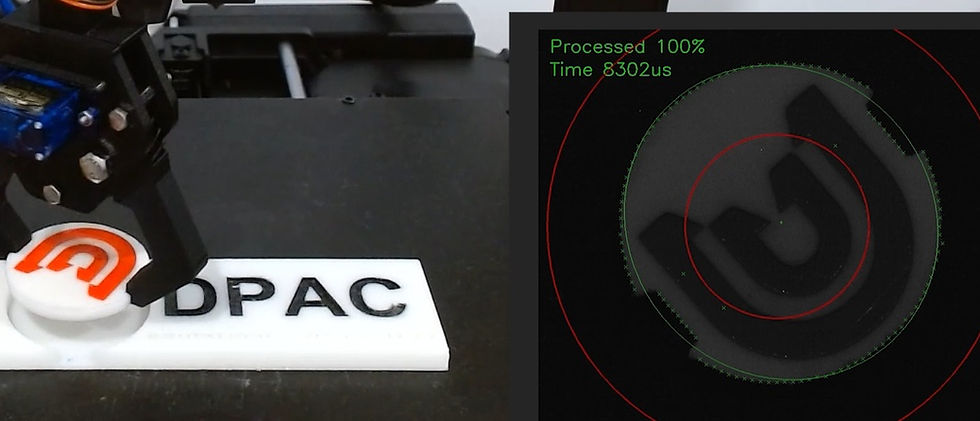
Our Pack-X and Arc-X vision system is selected and configured around the requirements of the application.
Robotic Vision Systems
Combining machine vision with industrial robotics creates flexible automated systems.
A camera can locate a component and provide its position to the robot. The robot can then pick, place, process or inspect the component automatically.
This is particularly useful where products are not always presented in exactly the same position.
Automated Inspection
Machine vision can perform repetitive inspection tasks consistently throughout production.
Instead of relying entirely on an operator to visually inspect every product, a vision system can automatically check defined characteristics and communicate the result to the machine control system.
This can be integrated with PLC control to automatically accept, reject or divert products.
Machine Vision and PLC Integration
A machine vision system normally forms part of a larger automation system.
The camera communicates inspection results to the PLC or automation controller, which can then determine the next machine action.
For example, the system can detect a defective component and automatically stop the process, activate a reject mechanism or record the result.
Machine Vision for Robot Guidance
Robot guidance is another important application of industrial vision.
A vision system can identify the location and orientation of a component before the robot picks it up.
This can reduce the requirement for highly precise part presentation and allow robots to perform more flexible handling operations.
Custom Machine Vision Systems
Every vision application is different.
Camera selection, lens, lighting, mounting position, processing requirements and software all affect the reliability of the inspection.
DPAC develops machine vision solutions as part of complete industrial automation systems, integrating vision with robotics, PLCs, HMI, motion control and machine safety.
Machine Vision Australia
DPAC Automation provides industrial machine vision integration from Ormeau, Queensland, servicing manufacturing and industrial applications throughout Australia.
If you need automated inspection, measurement, identification or robot guidance, DPAC can assess your application and develop a machine vision solution around your production process.


Comments